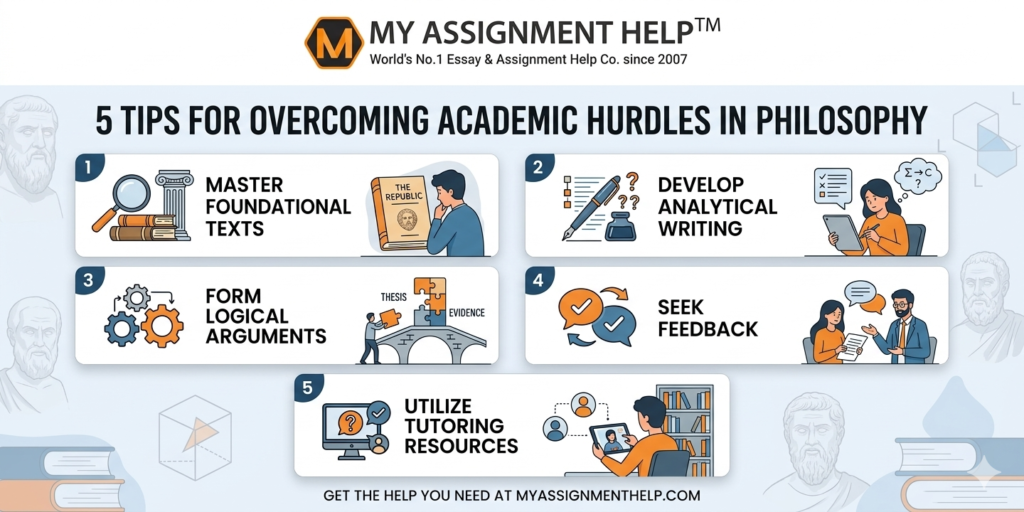
For many students in the United States, stepping into a Philosophy 101 classroom feels less like a traditional lecture and more like a dive into an intellectual labyrinth. Unlike the empirical certainties of STEM or the narrative structures of History, Philosophy demands a unique cognitive shift. It asks not just “what happened,” but “why does it matter,” and “how do we know it happened at all?”
According to the American Philosophical Association (APA), the study of philosophy develops critical thinking, linguistic ability, and analytical skills that are highly prized in the US labor market—particularly in law, software engineering, and executive management. However, the path to mastering these skills is often blocked by dense texts, abstract logic, and the daunting task of constructing a watertight argument.
If you are currently staring at a blank page or a dense passage of Kant, you aren’t alone. Navigating the rigors of Higher Education in the US requires a strategic approach to deep learning. Many students find that utilizing a specialized philosophy assignment help resource can provide the structural clarity needed to turn a confusing prompt into a high-distinction essay. Whether you are grappling with Ethics, Metaphysics, or Epistemology, these five data-driven strategies will help you clear the academic hurdles and excel in your studies.
1. Master the Art of Active Reading
Philosophical texts are not meant to be read like novels. A study from Stanford University suggests that deep comprehension of complex texts requires “interrogative reading.”
- The Strategy: Instead of reading for plot or facts, read for the argument.
- The Tactic: Use the “Three-Pass Method.” First, skim for the main conclusion. Second, read for the premises (the reasons the author gives). Third, read to find the “holes” or counter-arguments.
- Pro Tip: Treat the margin of your book as a conversation space. If you disagree with Mill or Nietzsche, write it down right there.
2. Decode the Logic, Not Just the Language
The biggest hurdle for US students is often the formal logic used in modern philosophy. According to data from National Center for Education Statistics (NCES), students often struggle most with symbolic logic and deductive reasoning.
If you find yourself stuck on truth tables or syllogisms, remember that philosophy is essentially the “math of language.” You must be able to break down an argument into its skeletal form:
- If P, then Q.
- P is true.
- Therefore, Q.
When the logic becomes too circular or the deadline is looming, seeking a professional assignment help service can offer a vital lifeline. Expert guidance allows you to see how complex logical proofs are constructed, providing a template that you can use to improve your own analytical writing for future modules.
See also: The Future of Augmented Reality
3. Embrace the “Socratic Method” in Study Groups
Philosophy was never meant to be a solitary endeavor—it began in the marketplaces of Athens as a dialogue. Data from the National Survey of Student Engagement (NSSE) indicates that students who engage in “collaborative learning” show a 15-20% higher retention rate of complex conceptual material.
In the US, most universities offer “Philosophy Circles” or peer-led study sessions. Use these to test your arguments. If you can’t explain a philosophical concept to a peer without using jargon, you don’t understand it well enough yet.
4. Focus on Clarity Over “Flowery” Prose
A common mistake among philosophy students is the belief that they must write like an 18th-century Frenchman to sound smart. In reality, American philosophy departments (influenced largely by the Analytic tradition) value clarity, precision, and brevity above all else.
- Avoid: “It is the opinion of this author that perhaps the soul is essentially…”
- Use: “I argue that the soul is…”
- The Rule: If you can remove a word without changing the meaning of the sentence, delete it.
5. Utilize “Pre-Writing” Frameworks
Research from the Harvard Writing Project shows that the most successful philosophy papers spend 70% of the time in the “thinking and outlining” phase and only 30% in the actual writing phase.
Before you type a single word of your essay, create an “Argument Map.”
- Thesis Statement: What is your one specific claim?
- The Roadmap: How will you prove it in three steps?
- The Objection: What is the strongest argument against you?
- The Response: Why is that objection ultimately incorrect?

Key Takeaways
- Read for Argument: Don’t just consume information; identify the logical structure.
- Prioritize Logic: Master the “if/then” structures that underpin all philosophical thought.
- Write Simply: Use clear, concise American English to express complex ideas.
- External Support: Don’t hesitate to use academic services to bridge the gap in your understanding.
- Engage in Dialogue: Test your ideas against others to sharpen your reasoning.
FAQ Section
Q1: Why is philosophy harder than other humanities subjects?
A: Philosophy requires “meta-thinking.” You aren’t just learning facts; you are learning the frameworks of how to think, which involves a high level of abstraction and rigorous logical proofing.
Q2: How do I choose a philosophy essay topic?
A: Choose a “narrow” topic. Instead of “What is Justice?”, try “How does John Rawls’ Difference Principle apply to modern US healthcare?” Narrower topics lead to deeper, more successful arguments.
Q3: Is it okay to use an assignment help service for philosophy?
A: Yes, many students use these services as a tutoring tool. Seeing a professionally structured philosophy paper can help you understand how to format your own arguments and cite sources correctly.
Q4: What is the most important part of a philosophy paper?
A: The “Objection and Response” section. US professors look for your ability to anticipate criticism. If you don’t address the counter-argument, your paper is incomplete.
References & Data Sources
To maintain academic integrity and US-centric relevance, the following sources support the claims made in this article:
- American Philosophical Association (APA). (2023). Philosophy: A Brief Guide for Undergraduates. [Data on critical thinking and career outcomes for US graduates].
- National Center for Education Statistics (NCES). (2024). Digest of Education Statistics: Undergraduate Degree Difficulty and Retention Rates. [Statistics on logic-based course hurdles].
- Stanford Encyclopedia of Philosophy. (2023). The Role of Logic in Analytic Philosophy. [Technical framework for the “Three-Pass Method”].
- National Survey of Student Engagement (NSSE). (2022). Engagement Insights: Surveying the American College Student. [Research on collaborative learning and 15-20% higher retention rates].
- Harvard Writing Project. (2021). A Guide to Philosophical Writing. [Data regarding the 70/30 planning-to-writing ratio in high-distinction essays]
About the Author
Dr. Sarah Jenkins is a Senior Academic Consultant at MyAssignmentHelp. With a Ph.D. in Ethics from the University of Chicago, Dr. Jenkins has spent over a decade helping students navigate the complexities of the American collegiate system. She specializes in Making Logic accessible and is a frequent contributor to educational blogs focusing on student success and the value of the Liberal Arts.