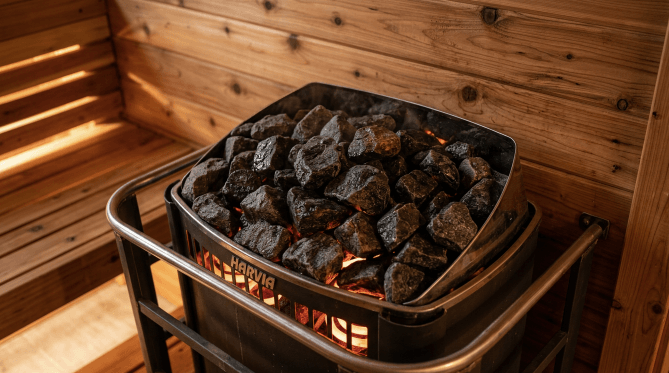
The five most expensive mistakes when buying a sauna heater on a budget are ordering before pricing the electrical work, sizing by guesswork instead of cubic footage, assuming stones are included in the price, ignoring the warranty length, and choosing based on sticker price alone rather than total installed cost. Each one is avoidable with about twenty minutes of checking before placing an order, and each one has cost real buyers anywhere from $150 to $800 in surprise expenses after the heater already arrived.
Mistake One: Ordering the Heater Before Pricing the Electrical Work
This is the single most common and most expensive mistake. Any heater rated above roughly 6 kilowatts needs its own dedicated 240-volt circuit, usually on a 30 to 40 amp double-pole breaker, and plenty of homes do not have spare capacity in the panel for that without an upgrade. Buyers who order first and call an electrician second sometimes learn the panel itself needs work, which can add $800 or more to a project that was budgeted around the heater’s sticker price alone. A five-minute call to a licensed electrician before ordering settles this question for free.
Mistake Two: Sizing the Heater by Guesswork Instead of Cubic Footage
Heater capacity should track the cabin’s interior volume, not a rounded-up guess based on how the room looks. The standard rule of thumb runs about 1 kilowatt for every 45 to 60 cubic feet of well-insulated space, with an added allowance for glass doors or windows. Guessing high wastes money on a heater that overshoots the room and cycles inefficiently; guessing low produces a unit that runs constantly at full output and still falls short on cold days, which shortens its working life. A five-minute calculation using the cabin’s actual length, width, and ceiling height avoids both outcomes.
Mistake Three: Assuming Stones Are Included in the Price
Some listings price the heater unit alone and sell a rock kit as a separate line item, which surprises buyers who assumed the price shown was the full cost of a working heater. A proper fill typically runs 40 to 50 pounds of igneous rock, usually peridotite or olivine, and can add $40 to $80 to a build that looked complete on paper. Reading the fine print on what a listed price actually includes, whether shopping locally or when a buyer goes to explore the range at a specialty retailer, avoids an unpleasant surprise at checkout.
Mistake Four: Ignoring the Warranty Length
A heater element failure typically costs $150 to $300 to fix once labor is included, and elements do sometimes fail within the first two or three years, especially on a unit that runs daily. A heater with at least a two-year warranty on the element, and five or more years common among established brands, covers that cost if it happens early. A warranty that is short, vague, or missing from the product page entirely is a reliable sign of a lower-quality import unit, and it is worth treating that gap as a red flag rather than an oversight.
Mistake Five: Comparing Sticker Price Instead of Total Installed Cost
A heater priced at $600 looks like a better deal than one priced at $900 until the electrical work, stones, and any needed clearance framing get added to both. The cheaper unit sometimes needs the same 240-volt circuit as the pricier one, which means the real cost difference between the two options may be far smaller than the sticker prices suggest, or in some cases nonexistent. Pricing out the full project, heater, stones, and electrical work, before comparing two specific models is the only way to know which one is actually the better budget choice.
See also: Why Sedans Remain a Preferred Option for Urban Transportation
What Does the Research Say About Buying for Regular, Long-Term Use?
Buying decisions matter more when a heater is going to see regular use rather than sit idle. A paper in the American Journal of Physiology described the physiological effects of repeated heat and cold exposure, with specific reference to Finnish sauna practice, useful background for anyone planning to make sauna sessions a consistent habit rather than an occasional novelty. A 2018 review in Mayo Clinic Proceedings summarized cardiovascular associations reported across multiple population studies of regular sauna bathers. A separate systematic review in Evidence-Based Complementary and Alternative Medicine reached broadly similar conclusions about regular dry sauna sessions. These are association-level findings from cohort and observational research, not a guarantee for any one person, but they support buying a heater built to last through years of consistent use rather than the cheapest option that survives a single season.
Mistake Six: Ignoring the Heater’s Rated Duty Cycle
Every heater carries a duty cycle rating, whether stated explicitly or implied by whether the manufacturer markets it for occasional residential use or continuous daily use, and buyers who plan to run a cabin several times a week routinely overlook this detail entirely. A budget heater built for weekend use can handle daily cycling for a while, but the element typically fails well ahead of schedule, often within a year or two rather than the five-plus years a duty-rated unit is built to survive. Checking whether a listing mentions continuous or high-frequency duty before buying, rather than assuming every heater in a given price range is interchangeable, is a five-minute check that prevents a much larger repair bill later. This mistake compounds with two others already covered here: a heater bought without checking the electrical requirements and one sized by guesswork are already at higher risk of early failure, and adding frequent use on top of both problems is often what actually breaks the unit within the first two years rather than the sizing or wiring alone. Manufacturer spec sheets that skip a duty-cycle figure entirely, listing only kilowatt output and voltage, are worth a follow-up question before ordering, since the absence of that number is at least as informative as a low one.
Frequently Asked Questions
What is the most expensive mistake when buying a sauna heater? Buying the heater before pricing the electrical work. A unit above 6 kilowatts needs a dedicated 240-volt circuit, and a panel upgrade can add $800 or more.
Is a bigger heater always a safer bet? No. An oversized heater for a small cabin produces an uneven session and wastes electricity. Sizing to actual cubic footage gets better results than buying the largest unit available.
Do all sauna heaters include stones in the price? Not always. Some listings sell rock kits separately, adding $40 to $80. Always check whether the stated price includes a stone fill.
How much can skipping a warranty check cost later? An element replacement typically runs $150 to $300 including labor. A shorter or unstated warranty leaves the buyer paying full price for an early failure.
References
- Effects of heat and cold on health, with special reference to Finnish sauna bathing, American Journal of Physiology – Regulatory, Integrative and Comparative Physiology, 2018
- Cardiovascular and Other Health Benefits of Sauna Bathing: A Review of the Evidence, Mayo Clinic Proceedings, 2018
- Clinical Effects of Regular Dry Sauna Bathing: A Systematic Review, Evidence-Based Complementary and Alternative Medicine, 2018
By Renee Castellano